Homogeneous or heterogeneous mixtures?
In everyday life, matter is rarely pure. Most of the time, we encounter mixtures.
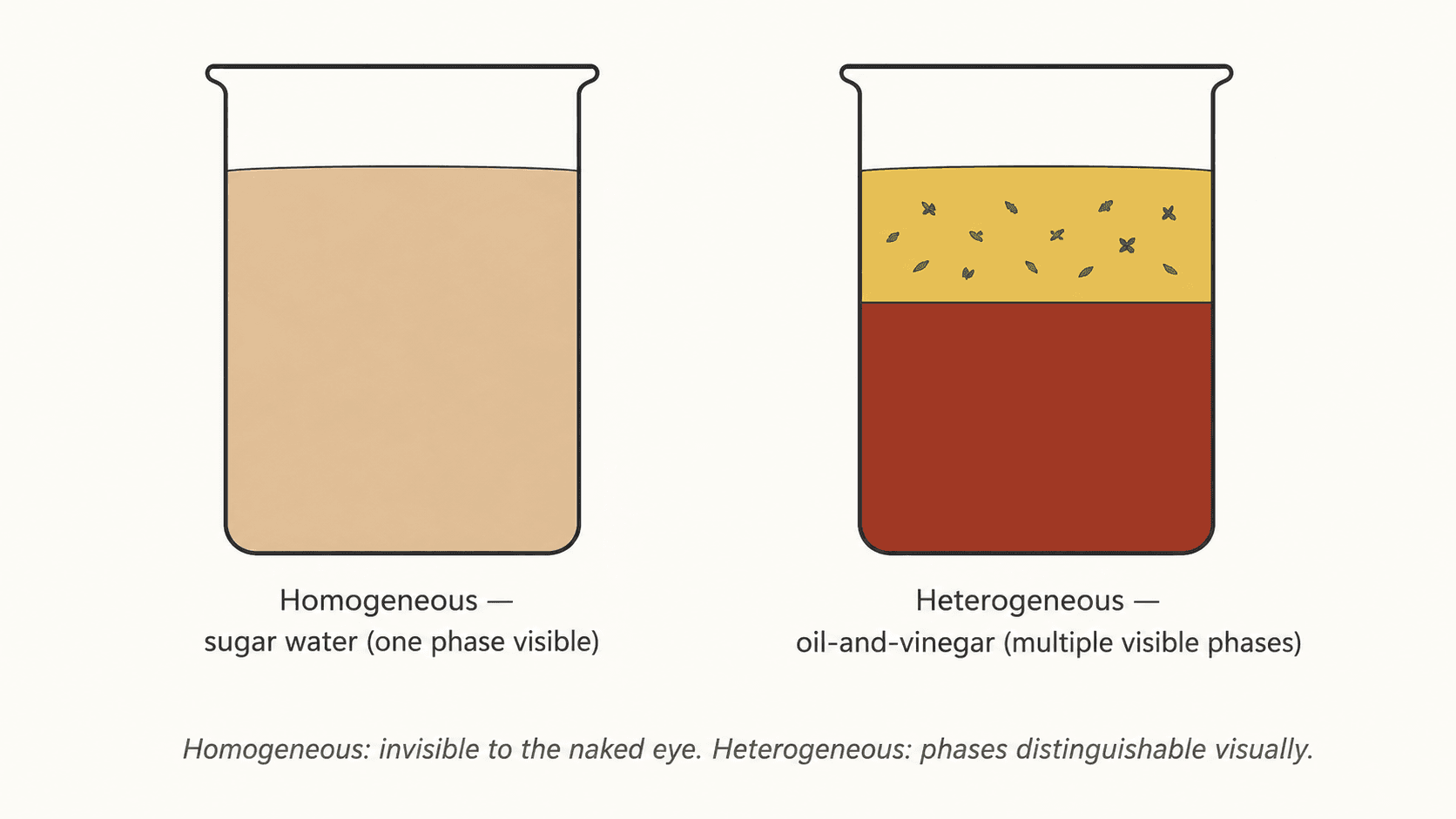
A homogeneous mixture is one in which you cannot distinguish the components by eye, even with a magnifying glass. Sugar water, clear apple juice, and air are homogeneous mixtures: they look uniform throughout.
A heterogeneous mixture is one in which you can see different components. Milk (before homogenization), salad dressing, and granite are heterogeneous: you can see multiple phases.
Solutions: solute and solvent
A solution is a homogeneous liquid mixture. It contains: - a solvent: the dissolving liquid (usually water); - one or more solutes: the dissolved substances.
When you dissolve sugar in water, water is the solvent and sugar is the solute. The result is called an aqueous solution.
Solubility and saturation
The solubility of a substance is the maximum mass of solute that can be dissolved in 100 g of solvent at a given temperature. Beyond this limit, the solution is saturated and extra solute will no longer dissolve.
Solubility depends on: - the nature of the solute and solvent; - temperature (solubility of solids usually increases with temperature).
Example: the solubility of table salt (sodium chloride) in water is about 36 g per 100 g of water at 20 °C.
Separating a mixture
Several techniques can separate the components of a mixture:
| Technique | Principle | Example |
|---|---|---|
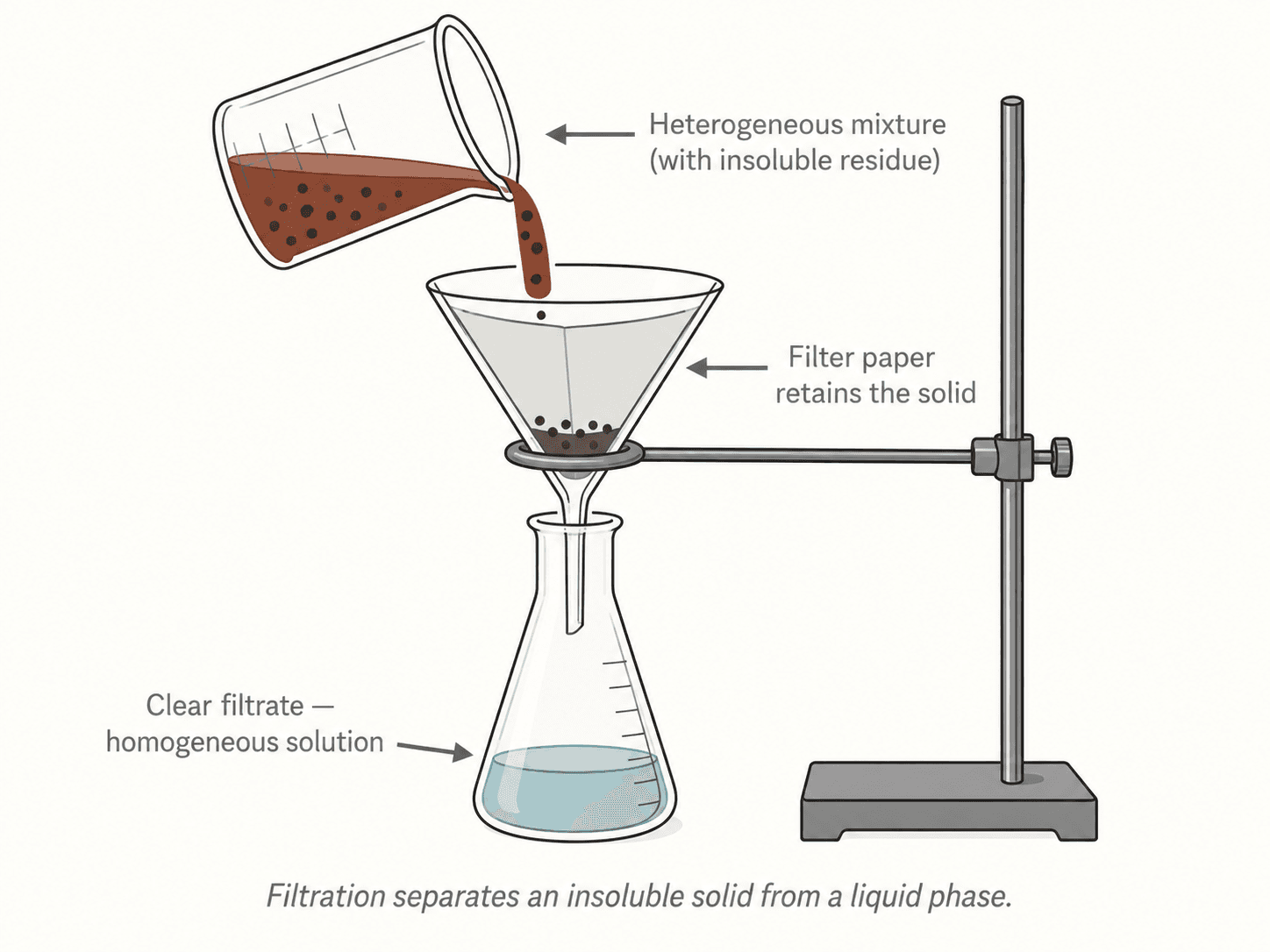
| Filtration | Retain undissolved solids | Separate sand from water |
| Decantation | Let phases settle by gravity | Separate oil and water |
| Evaporation | Vaporise the solvent | Recover salt after water evaporates |
| Distillation | Heat then condense | Separate alcohol from water |
Is water a universal solvent?
Water is sometimes called the "universal solvent." In reality, water dissolves ionic substances (such as salt) and many polar substances very well (such as sugar, which dissolves without forming ions), but it does not dissolve fats or oils. To clean a grease stain, an organic solvent (acetone, white spirit) is needed.
Finished this lesson?