Why measure concentration?
When preparing a solution, the amount of dissolved solute matters a great deal. Overly salty water is undrinkable; an overly concentrated medicine is dangerous. Chemists need a precise quantity to capture this: mass concentration.
Definition and formula
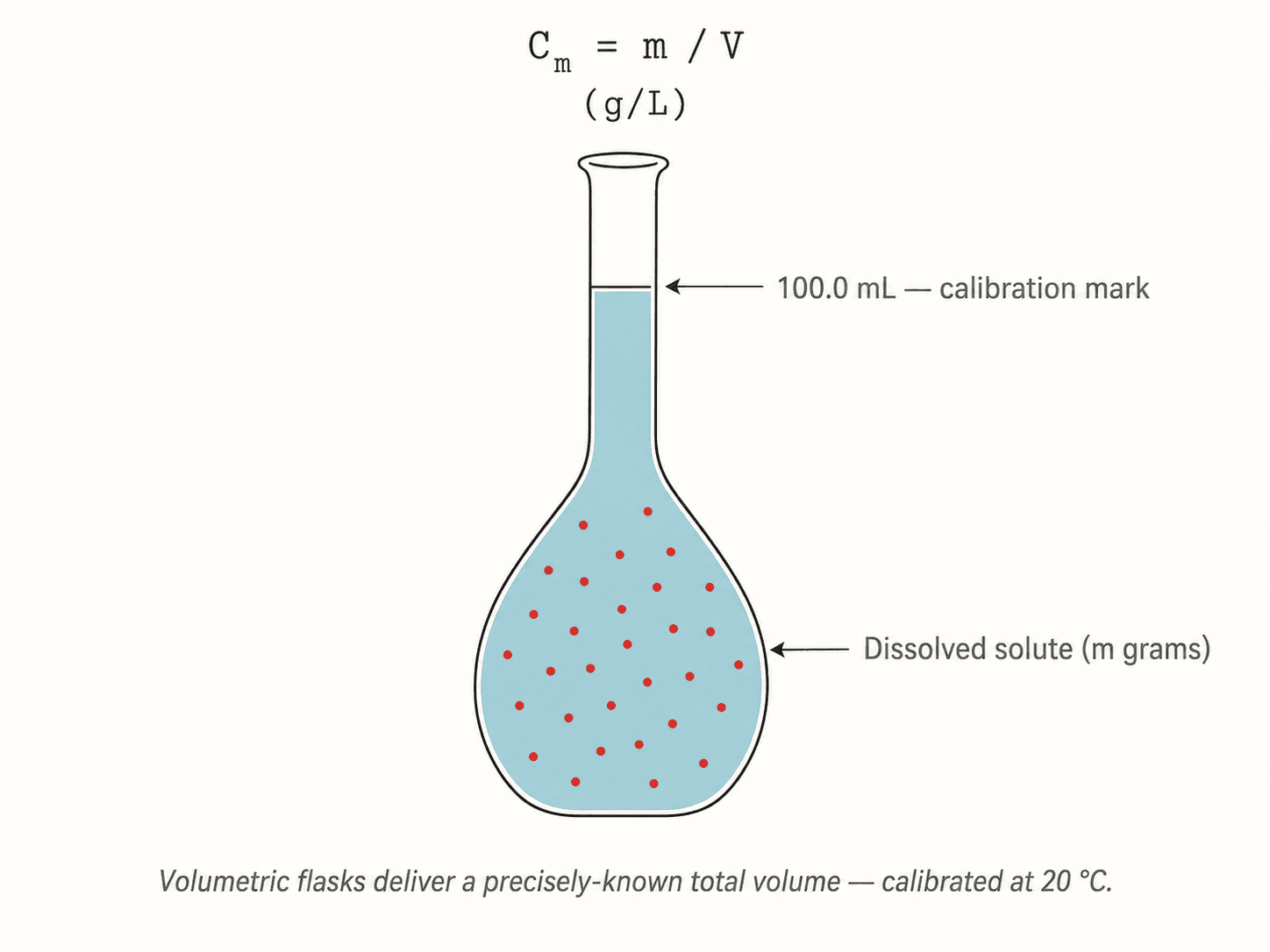
The mass concentration (written C_m) of a solution is the mass of solute dissolved per litre of solution:
C_m = m_solute / V_solution
- m_solute is in grams (g)
- V_solution is in litres (L)
- C_m is in grams per litre (g/L)
Everyday examples
| Solution | Approx. concentration (g/L) |
|---|---|
| Seawater | 35 |
| Physiological saline | 9 |
| Isotonic sports drink | 6 |
| Sweet water (tea) | 5–30 |
Physiological saline (sodium chloride solution at 9 g/L) is a great example: its concentration is chosen precisely to be compatible with the body's cells.
Calculating with the formula
From C_m = m / V, two more formulas follow: - m = C_m × V (mass of solute needed to prepare V litres at concentration C_m) - V = m / C_m (volume of solution obtained by dissolving mass m)
Example 1: 15 g of sugar is dissolved in 500 mL of water. What is the concentration? V = 500 mL = 0.5 L C_m = 15 / 0.5 = 30 g/L
Example 2: Prepare 200 mL of saline at C_m = 9 g/L. What mass of salt is needed? m = 9 × 0.2 = 1.8 g
Watch out for unit conversions
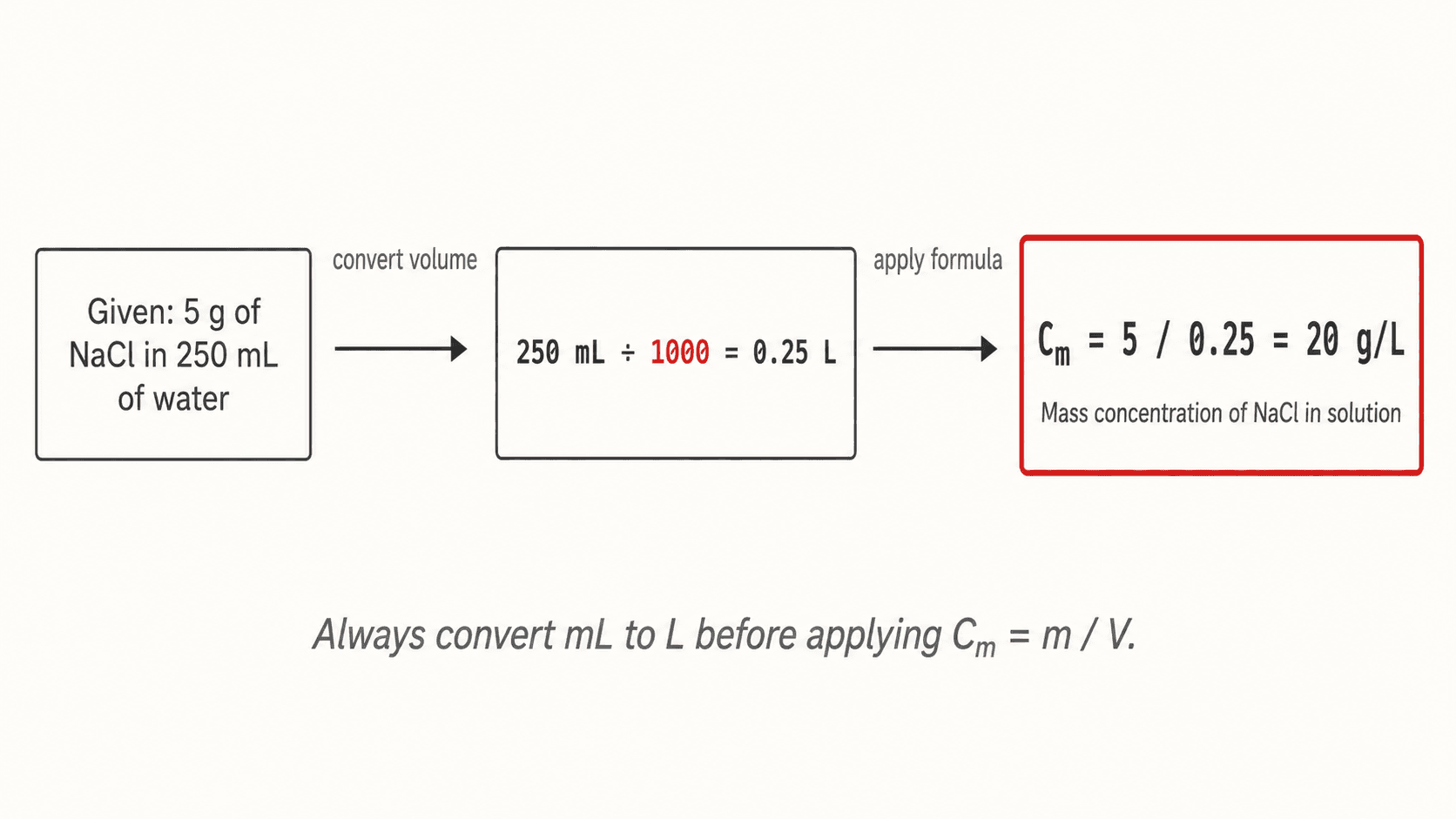
The formula uses litres. If volume is given in millilitres, convert first:
1 L = 1 000 mL, so V (in L) = V (in mL) / 1 000
This is the most common mistake in exercises!
Concentration vs density
Mass concentration and density look similar (both in g/L or g/cm³) but they are not the same: - Density characterises a pure substance. - Mass concentration characterises a solute in a solution.
Finished this lesson?