Pressurized Water Reactor (PWR)
The most widely deployed nuclear reactor design in the world (~70 % of the fleet). Primary-loop water, pressurized to 155 bar to stay liquid at 320 °C, carries fission heat from UO₂ fuel to a steam generator that feeds the turbine.
Operating conditions
- Temperature
- 280-320°C
- Pressure
- 155bar
- Catalyst
- U-235 enrichi (3-5 %), modérateur H₂O, contrôle B/Cd
- Phase
- liquid
How it works
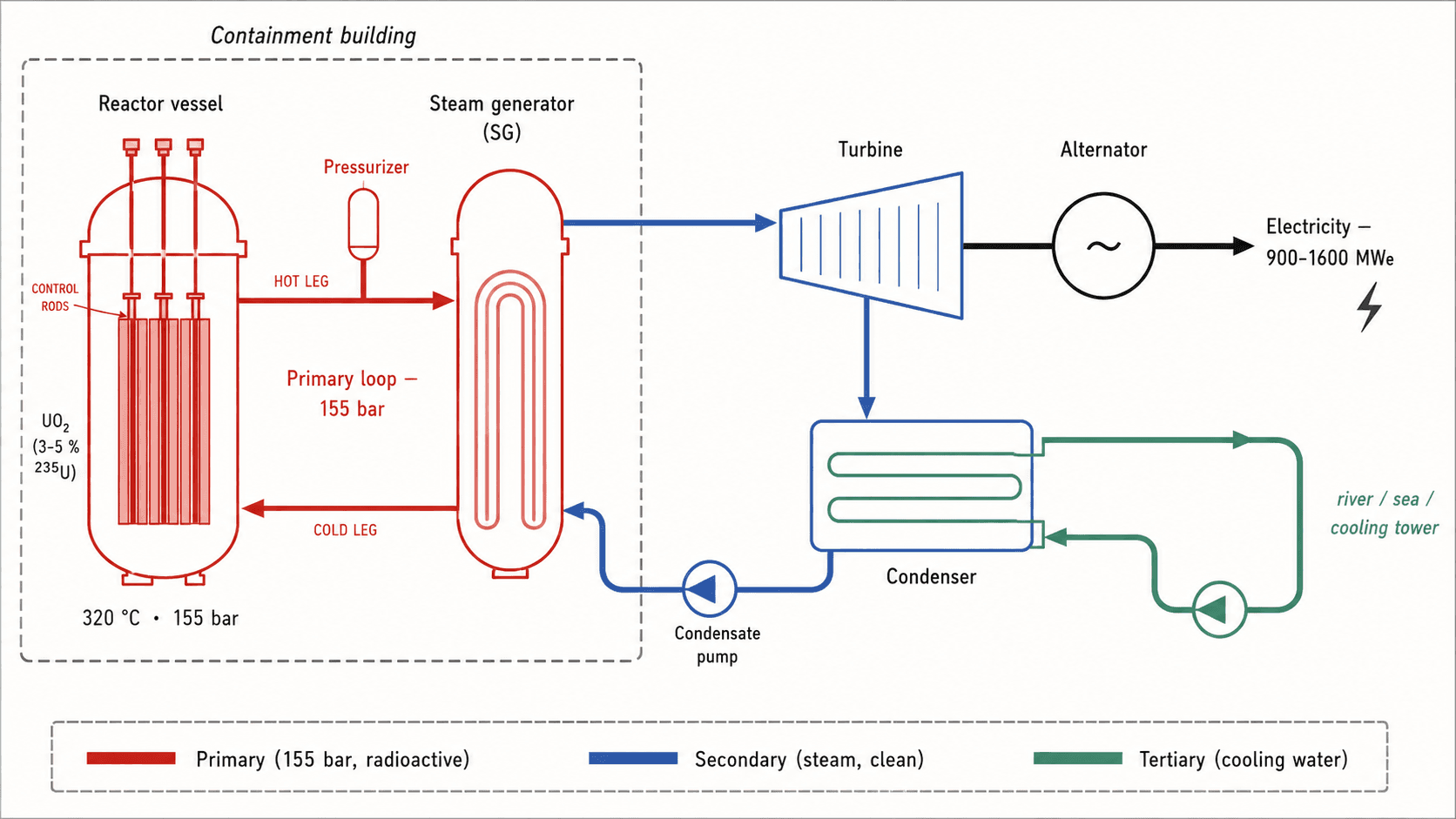
How it works
Electricity from fission or fusion
Key components
The role of each main part, and the elements / compounds it involves.
Containment building
Last safety barrier — contains radioactivity even in case of primary loop rupture or partial core meltdown.
Cylindrical pre-stressed concrete building (~1 m thick), often lined with a sealed metal liner. Designed to withstand internal overpressure (~5 bar), aircraft impact, and earthquakes. EPR (Gen III+) plants use a double containment with a ventilated under-pressure annulus for near-total tightness.
Béton précontraint ~1 m · résiste 5 bar interne · double peau (EPR)
Reactor vessel
Houses the core (fuel assemblies + control rods) immersed in pressurized primary water.
Single-piece forged steel cylinder, dished bottom, ~12 m tall, ~4-5 m diameter, walls 20-25 cm thick. Pressurized to 155 bar to keep water from boiling at 320 °C. Outgoing neutrons are absorbed by a vessel internally clad in stainless steel. The vessel is the non-replaceable item that defines the reactor's lifetime (40-80 years).
Acier forgé · 155 bar · 320 °C · 12 m × 4-5 m · paroi 20-25 cm
See alsouo2h2ofeUO₂ fuel assemblies
Site of nuclear fission — the energy from each fissioned ²³⁵U becomes heat in the primary coolant.
UO₂ ceramic pellets (Ø 8-9 mm × 10 mm tall) sintered and stacked inside zirconium-alloy cladding (Zircaloy or M5™), forming ~4 m fuel rods. ~250 rods per assembly, ~150-200 assemblies per core. ²³⁵U enrichment is 3-5 % (vs 0.72 % natural). Each fission releases ~200 MeV — about 80 GJ per gram of fissioned ²³⁵U.
Pastilles UO₂ Ø 8 mm · gaine zirconium · enrichissement ²³⁵U 3-5 %
See alsouo2uControl rods
Regulate power and shut down the chain reaction by absorbing free neutrons.
Rods made of Ag-In-Cd alloy (80 % Ag, 15 % In, 5 % Cd) or B₄C, lowered between fuel rods from the top of the vessel. Boron and cadmium have huge thermal-neutron capture cross-sections. Full insertion during emergency shutdown ('scram'): ~2 seconds. Fine power regulation also uses soluble boron in the primary water (~600 ppm at start of cycle).
Ag-In-Cd ou B₄C · scram en ~2 s · bore soluble 0-1500 ppm
See alsobcdaginSteam generator
Heat exchanger between the primary loop (radioactive) and the secondary loop (clean water that boils).
Vertical cylinder (~21 m tall, ~5 m diameter) containing ~5500 U-tubes in Inconel 690 alloy (resistant to stress-corrosion cracking). Primary water at 320 °C flows inside the tubes, secondary water at 70 bar bathes them from the outside and boils at 285 °C. Heat exchange surface ~7000 m². Each PWR has 3 or 4 of these — their integrity is critical: a tube leak is the most closely watched incident in the fleet.
Inconel 690 · ~5500 tubes en U · ~7000 m² · 70 bar / 285 °C secondaire
See alsoh2ofenicrPressurizer
Holds the primary loop pressure at 155 bar to prevent boiling at 320 °C.
Vertical vessel partly filled with water, capped by a steam cushion (saturated liquid/vapor equilibrium at 345 °C / 155 bar). Thermal expansion of the heated primary fluid raises water level and compresses the steam — pressure rises. Electric heaters at the bottom and cold-water sprays at the top give fine control (±2 bar). If pressure drifts too much, relief valves discharge steam to a quench tank.
155 bar · 345 °C · chauffages électriques + spray · soupapes sûreté
Turbine-alternator
Converts steam's kinetic energy into electricity (~37 % net efficiency).
Multi-body steam turbine (HP + 2 or 3 LP stages) spinning at 1500 or 3000 rpm, coupled to a hydrogen-cooled synchronous alternator. A 1300 MWe PWR turbine consumes ~6500 t/h of steam. Carnot efficiency caps at ~40 % (saturated steam at 285 °C, cold sink at 25 °C) — hence the importance of a good cold sink. This is the 'classical' part of the process, identical to a gas or coal plant.
HP + LP · 1500-3000 tr/min · ~6500 t/h vapeur · rendement net ~37 %
Tertiary condenser
Condenses the spent steam from the turbine in a closed loop, sending it back to the steam generator.
Massive heat exchanger (~30,000 m² of brass or titanium tubes) cooled by river water, seawater, or cooling-tower water. The vacuum created by condensation (~50 mbar absolute) boosts turbine efficiency. A 1300 MWe plant typically rejects 2000 MW of waste heat to the tertiary loop — hence the iconic white plumes from cooling towers (pure water vapor, no radioactivity).
~30 000 m² · vide ~50 mbar · ~2000 MW chaleur rejetée · panache = vapeur pure
See alsoh2o
Physical and chemical principles
The fundamental laws that make this process possible — and the constraints they impose.
Controlled nuclear chain reaction
A thermal neutron hits a ²³⁵U nucleus → fission into two fragments + 2 or 3 neutrons + ~200 MeV. If each fission produces on average exactly 1 neutron that causes another fission (k_eff = 1), the reactor is critical: power stays constant. Above, power climbs; below, it decays. All control consists of holding k_eff close to 1 via control rods and soluble boron.
²³⁵U + n → ¹⁴¹Ba + ⁹²Kr + 3 n + ~200 MeVNeutron moderation by water
Neutrons born from fission are fast (~2 MeV) and too energetic to efficiently fission ²³⁵U. Water slows them via elastic collisions with H₂O protons — typically 18-20 collisions to drop to ~0.025 eV (thermal speed). At that energy ²³⁵U's fission cross-section is ~580 barns, vs ~1 barn for fast neutrons. That's why a PWR needs water in the core — without it the reaction dies.
n_rapide + H_eau → n_thermique (~0,025 eV)Two-phase heat transport and Rankine cycle
Primary water stays liquid at 320 °C thanks to 155 bar, carries heat to the steam generator. Secondary water at 70 bar boils there at 285 °C, becomes superheated steam, expands through the turbine releasing its kinetic energy, then is recondensed in the condenser. A classical Rankine cycle — identical to a coal plant, except the heat source is nuclear.
η_Carnot ≈ 1 − T_froide / T_chaude ≈ 40 % théo · ~37 % réel
Compounds involved
Main applications
- Low-carbon baseload electricity95 %
- Industrial heat cogeneration3 %
- Seawater desalination1 %
- Naval military propulsion1 %
Generation IV, SMR and closing the fuel cycle
- SMR (Small Modular Reactors) : réacteurs ~300 MWe préfabriqués (NuScale, Rolls-Royce SMR, NUWARD)
- EPR (gen III+) : récupérateur de corium, redondance quadruplée, double enceinte (Flamanville 3, Hinkley Point C)
- Combustible MOX : recyclage du Pu issu du retraitement (jusqu'à 30 % du cœur en France)
- Combustible ATF (Accident Tolerant Fuel) : gainages SiC ou revêtements Cr pour ralentir l'oxydation en cas d'accident
- Surveillance des cuves par éprouvettes témoins pour prolonger l'exploitation à 60-80 ans
- Réacteurs de IV génération (sels fondus, gaz à haute température, métal liquide) — démonstrateurs en cours
Similar or competing processes
Related industrial processes — alternative chemistry, alternative technology.
- centrale-bwr
Boiling water reactor: water boils directly in the vessel (~70 bar). Single loop, no steam generator — simpler but the turbine steam is radioactive.
- centrale-candu
Canadian heavy-water reactor (D₂O): can use unenriched natural uranium thanks to D₂O's very low neutron absorption. On-load refueling.
- epr
Gen III+ evolution of the French/German PWR: 1600-1700 MWe, passive safety, 60+ year lifetime (Flamanville 3, Olkiluoto 3, Hinkley Point C).
- reacteur-sels-fondus
Molten salt reactor (Gen IV): fuel dissolved in liquid fluoride salts at 700 °C — intrinsic safety, higher efficiency, reduced waste. Demonstrators underway (TerraPower, Copenhagen Atomics).