Boiling Water Reactor (BWR)
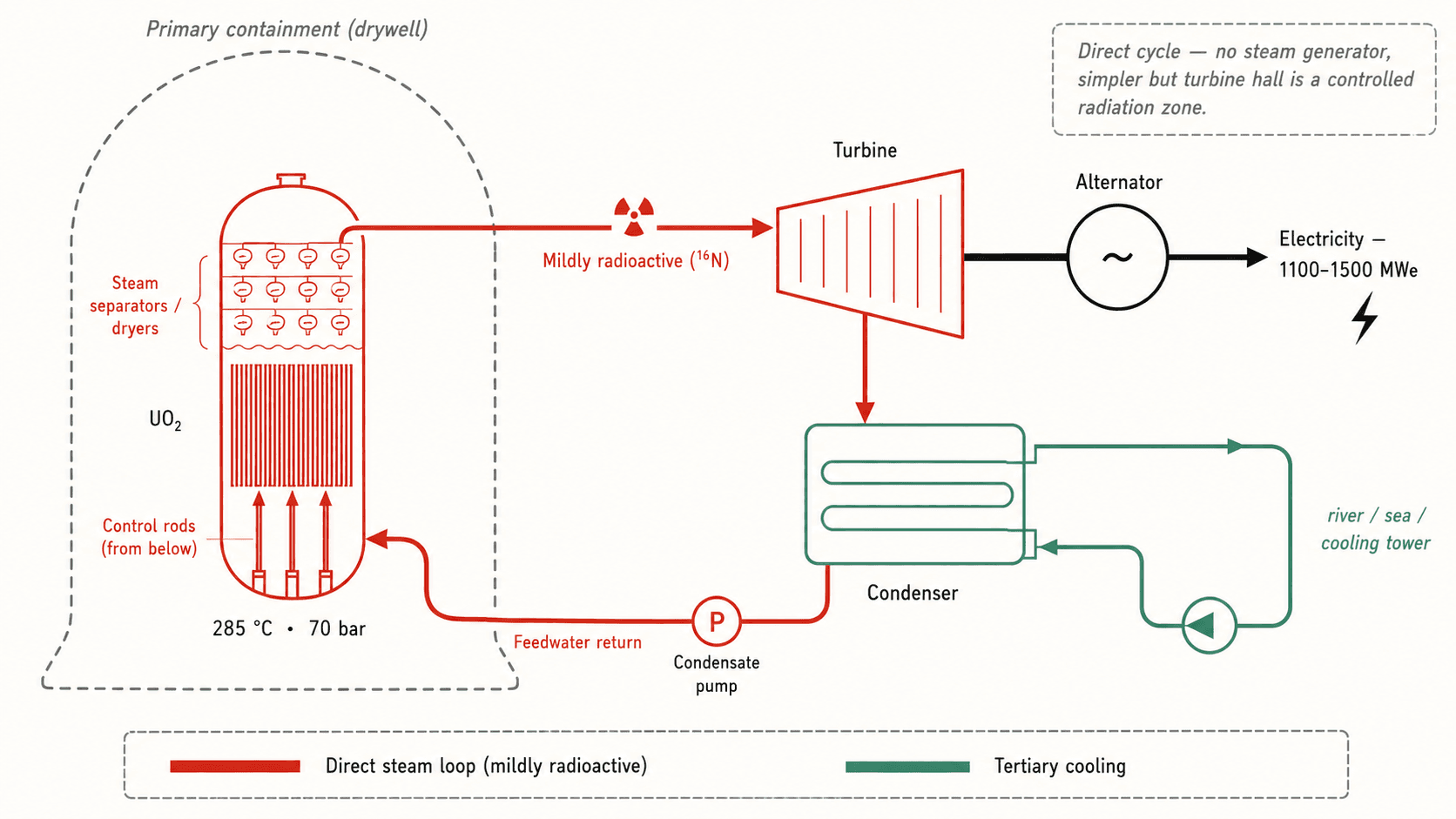
Direct-cycle nuclear reactor: core water boils at 285 °C / 70 bar to produce the steam that drives the turbine directly, without a secondary loop. ~70 reactors in service (~25 % of the world fleet), mainly in the United States, Japan and Sweden.
Operating conditions
- Temperature
- 285°C
- Pressure
- 70bar
- Catalyst
- Aucun (réaction nucléaire)
- Phase
- two-phase (water + steam)
How it works
How it works
Electricity from fission or fusion
Key components
The role of each main part, and the elements / compounds it involves.
BWR pressure vessel
Contains the core, steam separator and dryer — the entire thermohydraulic chain fits in a single envelope.
Cylindrical ferritic-steel vessel about 21 m tall and 6 m in diameter, taller than a PWR vessel (15 m) because it houses internal steam separation and drying. Operating pressure 70 bar, temperature 285 °C. Wall thickness (~150 mm) is lower than in a PWR thanks to the lower pressure — an economic advantage of the design.
21 m × 6 m · 70 bar · 285 °C · acier ferritique
UO₂ fuel core
Sustains controlled fission of ²³⁵U and boils the cooling water.
~600 to 800 fuel assemblies (depending on reactor size), each made of 92 UO₂ rods enriched 3-5 % in ²³⁵U inside zircaloy cladding. Control rods (B₄C or Ag-In-Cd) are inserted from the bottom — a BWR specificity — because the top is taken up by the steam separators. Fuel cycle typically lasts 18 to 24 months before refuelling.
600-800 assemblages · UO₂ enrichi 3-5 % · gaine zircaloy
See alsouo2Steam separator and dryer
Separates steam from water droplets to deliver dry steam to the turbine.
Above the core, the water/steam mixture first crosses ~250 cyclones (centrifugation), then a chevron-plate dryer. Outlet steam contains less than 0.1 % moisture, a necessary condition to avoid eroding turbine blades. Separated water falls back to the core via a downcomer — providing the primary loop's natural convection.
~250 cyclones · sécheur chevronnes · humidité < 0,1 %
Jet recirculation pumps
Modulate core flow without moving parts inside the vessel.
An elegant BWR specificity: 16 to 24 jet pumps (no rotor) inside the vessel, fed by 2 external recirculation loops. Varying their flow shifts core-outlet void fraction, which is a fast power-modulation lever (without moving control rods). BWR/4 and /6 use this principle; ABWR replaces them with sealed internal pumps (RIP).
16-24 pompes à jet · 2 boucles externes · régulation par débit
Mark I/II/III containment
Contains radioactivity in case of accident, using a pressure suppression pool.
Iconic design: a pear-shaped drywell hosting the vessel, connected via downcomers to a torus partially filled with water (wetwell). In case of steam leak, steam crosses the wetwell which condenses it — internal pressure is limited. Mark I (Fukushima) is compact but has little free volume; Mark II and III enlarge the containment. Recent BWRs (ABWR, ESBWR) use a simpler cylindrical containment.
Drywell + wetwell · suppression pression vapeur · Mark I/II/III · cylindrique sur Gen III+
Physical and chemical principles
The fundamental laws that make this process possible — and the constraints they impose.
Direct steam cycle — simplicity vs radioprotection
Where the PWR separates the primary loop (radioactive, pressurized) from the secondary loop (clean) via a steam generator, the BWR uses a single water flow through core, turbine and condenser. This is thermohydraulically simpler and cheaper in capex, but requires the entire turbine hall to be classified as a controlled radiation zone because of residual steam radioactivity (mainly ¹⁶N, half-life 7.1 s — radioactivity vanishes quickly at shutdown).
Une seule boucle eau-vapeur · ¹⁶O(n,p)¹⁶N en cœurNegative void coefficient (passive safety)
The more water boils in the core, the larger the steam (void) fraction, the lower the neutron moderation (steam is ~1000× less dense than liquid water). Less moderation = fewer thermal fissions = less power. This feedback loop is inherently stabilising: a local runaway self-extinguishes. It is one of the key advantages of BWRs over Soviet RBMKs (which had a positive coefficient, the root cause of Chernobyl).
α_void < 0 → P diminue quand fraction vapeur augmente
Compounds involved
Main applications
- Base-load electricity generation95 %
- Industrial heat production (rare)5 %
Fukushima legacy and shift to passive safety
- Refroidissement passif gravitaire (~72 h sans alimentation)
- Recombineurs catalytiques d'hydrogène (passive autocatalytic)
- Récupérateurs de corium (core catcher)
- Pompes internes étanches (RIP) à la place des pompes à jet (ABWR)
- BWRX-300 — SMR de 300 MWe en cycle direct simplifié
Similar or competing processes
Related industrial processes — alternative chemistry, alternative technology.
- Pressurized Water Reactor (PWR)
Dominant competing technology (~70 % of the world fleet); indirect cycle with secondary loop separated from the core — non-radioactive turbine.
- candu
Canadian heavy-water natural-uranium reactor — no enrichment needed, but more complex infrastructure.
- molten-salt-reactor
Molten salt reactor (Gen IV): fuel dissolved in liquid salt at atmospheric pressure, intrinsic passive safety. Still at demonstrator stage.