Ostwald process
Catalytic oxidation of ammonia (from Haber-Bosch) on a platinum-rhodium gauze to produce nitric acid. Coupled with Haber-Bosch, it's the backbone of the fertilizer and explosives industry.
Operating conditions
- Temperature
- 850-950 (gauze) ; 30-50 (absorption)°C
- Pressure
- 4-12bar
- Catalyst
- Pt-Rh (90/10 ou 95/5) gauze tissée
- Phase
- gas + liquid
How it works
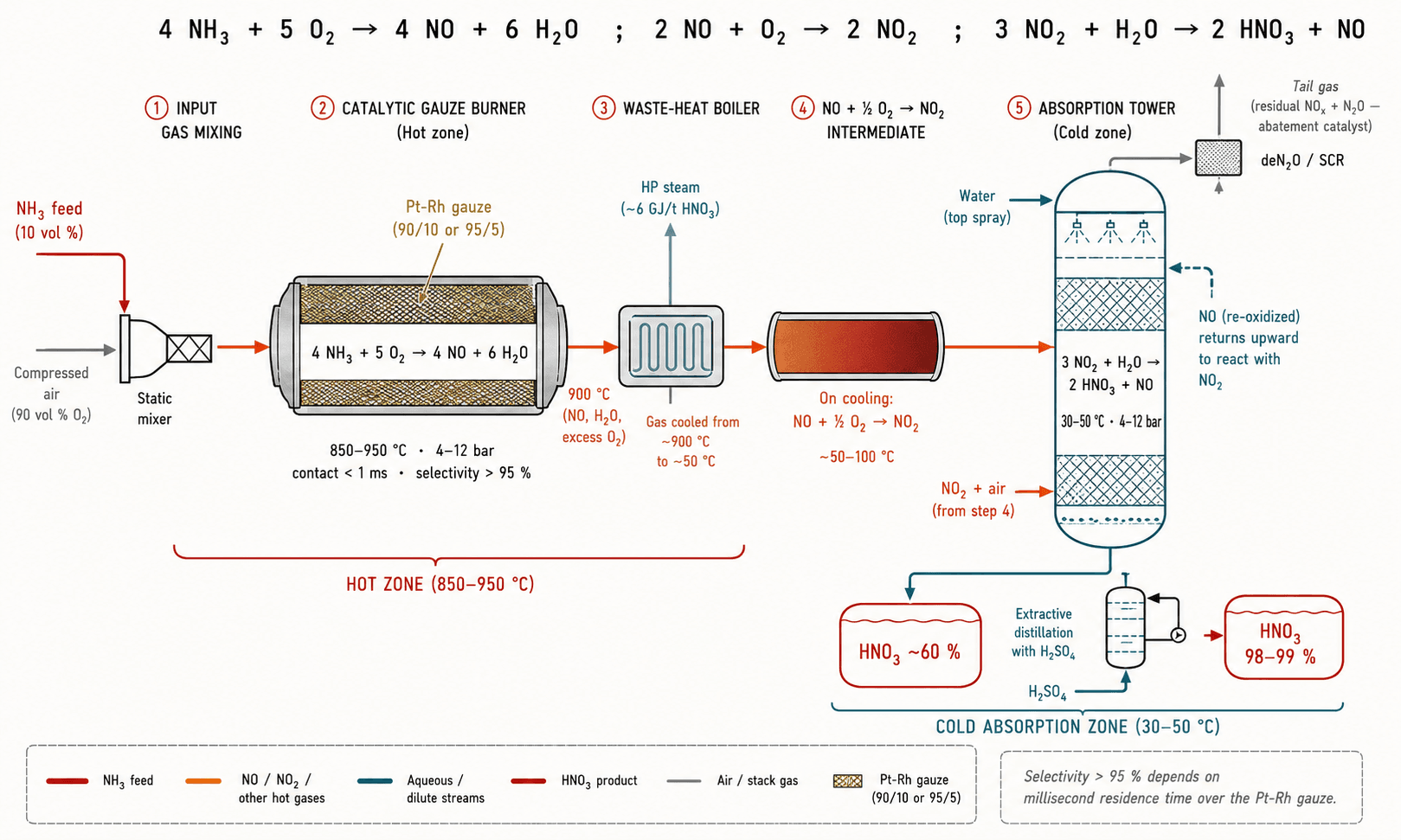
How it works
Molecular synthesis through controlled chemical reactions
Key components
The role of each main part, and the elements / compounds it involves.
Pt-Rh gauze
Selective oxidation catalyst NH₃ → NO. The heart of the process.
Fine metal weave (wire Ø ~75 µm) of Pt-Rh alloy (90/10 or 95/5 depending on operating pressure), stacked as 5-30 overlaid grids. Specific surface ~1 m²/g. Selectivity > 95 % for NO. Pt losses by evaporation: ~0.1-0.3 g Pt per tonne acid produced — captured downstream on Pd gauzes that recover ~80 % of volatile Pt.
Pt-Rh 90/10 ou 95/5 · 5-30 grilles · pertes Pt 0,1-0,3 g/t · récupération Pd
See alsonh3NO waste-heat boiler
Cools NO gases from 900 °C to 200 °C while producing HP steam.
Tubular heat exchanger in austenitic stainless steel 304L or 316L, designed to resist moist NOₓ corrosion. Steam produced ~40 bar / 380 °C. Gradual cooling to avoid premature water condensation (which would dissolve NO into unstable HNO₃ and cause local corrosion).
Inox 304L/316L · vapeur 40 bar / 380 °C · refroidissement contrôlé
NO₂ absorption tower
Converts cooled NOₓ to HNO₃ by counter-current contact with water.
Cylindrical tower 30-50 m tall, 3-4 m in diameter, stainless steel, pressurized at 4-12 bar. Valve trays or structured packing (Sulzer Mellapak™) to maximize NOₓ/H₂O transfer. Water in at the top, NOₓ gas at the bottom, concentrated acid out at the bottom (60-65 wt %). External coil cooling to stay < 50 °C (NO₂ solubility falls exponentially with T).
30-50 m · 4-12 bar · acide sortant 60-65 % · cooling externe
See alsohno3N₂O abatement catalyst
Decomposes parasitic N₂O (strong greenhouse gas) before atmospheric release.
Secondary catalytic bed (Fe-zeolite or mixed Co-Ce-Al oxide) downstream of the gauze, at 800-900 °C. Decomposes 2 N₂O → 2 N₂ + O₂ at 90-99 % efficiency. Made mandatory in the EU and under Kyoto (each tonne N₂O avoided counts as 265 t CO₂-eq carbon credit). Example: Yara Porsgrunn eliminated > 30 kt N₂O/year as early as 2009.
Fe-zéolite ou Co-Ce-Al · 800-900 °C · efficacité 90-99 %
Physical and chemical principles
The fundamental laws that make this process possible — and the constraints they impose.
Short-contact selectivity (millisecond chemistry)
On the Pt-Rh gauze, two competing reactions consume NH₃: oxidation to NO (desired) and combustion to N₂ (parasitic, irreversible). At 900 °C, kinetics toward NO are faster during the first millisecond of contact, then NO starts reducing back to N₂. The thin gauze (low mass, low volume) ensures residence time < 1 ms — the reason for choosing a woven grid over a granular fixed bed.
Applies to componentsgauze-pt-rhGas/liquid oxidation cascade
Three equilibria stack up in the absorption tower: NO + ½ O₂ ⇌ NO₂ (gas, slow), 2 NO₂ ⇌ N₂O₄ (gas, fast), 3 NO₂ + H₂O → 2 HNO₃ + NO (gas/liquid interface). Regenerated NO rises and re-loops. High pressure (4-12 bar) accelerates all three steps. The engineer's art lies in dimensioning heights and temperatures to minimize NOₓ losses.
Applies to componentstour-absorption-no2
Compounds involved
Input
Output
World production
Main applications
- Fertilizers (ammonium nitrate NH₄NO₃, urea-nitrate)80 %
- Explosives (TNT, nitroglycerin, ANFO)8 %
- Organic chemistry (aromatic nitration)6 %
- Metallurgy (passivation, etching), miscellaneous6 %
Fugitive N₂O and the cost of Pt
- Catalyseurs d'abattement N₂O secondaire (Fe-zéolite) — −95 % d'émissions
- Grilles de récupération Pd en aval — +5-10 % de Pt récupéré
- Optimisation pression / sélectivité (procédés mono- et duo-pression)
- Couplage HNO₃ vert avec NH₃ vert (Haber-Bosch électrolytique)
Similar or competing processes
Related industrial processes — alternative chemistry, alternative technology.