Hall-Héroult process
Electrolysis at 950-980 °C of alumina dissolved in molten cryolite (Na₃AlF₆) to produce aluminium metal. Universal since 1886 — it alone consumes ~3 % of world electricity.
Operating conditions
- Temperature
- 950-980°C
- Pressure
- 1bar
- Catalyst
- Cryolithe Na₃AlF₆ fondue + AlF₃ + CaF₂
- Phase
- liquid
How it works
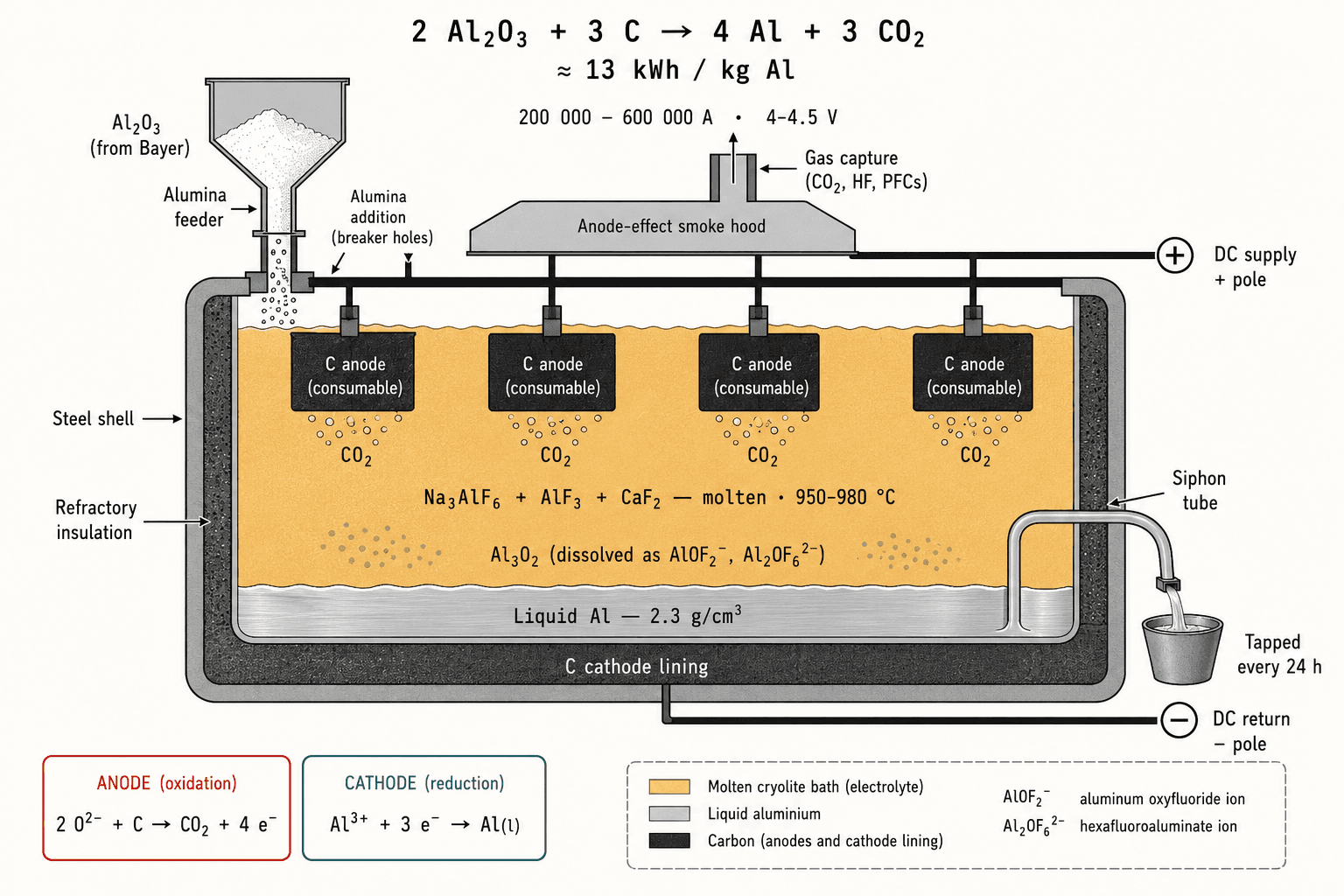
How it works
Decomposition driven by electric current
Key components
The role of each main part, and the elements / compounds it involves.
Reduction cell (pot)
Electrolysis reactor — holds the molten cryolite bath and the liquid aluminium produced.
Rectangular cell ~10 × 4 × 1.2 m, steel shell internally lined with carbon blocks (cathode) then an insulating frozen-alumina crust. The cell tilts slightly and a siphon draws off the molten Al collected at the bottom. A modern plant lines up 200-300 cells in series, forming a 'potline' fed by a single giant rectifier.
10 × 4 × 1,2 m · 200-600 kA · 4-4,5 V · 200-300 cuves en série
Carbon anodes
Supply electrons and are consumed by reaction with the released oxygen.
Pre-baked carbon blocks (Söderberg technology nearly extinct) made from calcined petroleum coke + coal-tar pitch, baked at 1200 °C. ~1.5 × 0.7 × 0.5 m, ~1 t each. A cell holds 20-30 anodes, replaced every 25-30 days. Consumption: ~400 kg carbon per tonne Al — this is what makes the process an irreducible CO₂ emitter (at least ~1.5 t CO₂/t Al just from the anodes).
Coke Pb + brai · cuit 1200 °C · ~400 kg C/t Al · changement /25-30 j
Electrolytic bath (cryolite + AlF₃)
Molten ionic solvent that dissolves alumina and carries current between anode and cathode.
Na₃AlF₆ (cryolite) + AlF₃ (8-12 % excess) + CaF₂ (~5 %) + 2-4 % dissolved Al₂O₃. This composition lowers the melting point of Al₂O₃ from 2050 °C to ~960 °C — the central trick of the process. Natural cryolite (Greenland) being exhausted, it's synthesized from fluorspar + hydrofluoric acid. Fluoride losses: 15-25 kg F/t Al — partially captured by the off-gas treatment system.
Na₃AlF₆ + 8-12 % AlF₃ + 5 % CaF₂ · Tf ~960 °C · 2-4 % Al₂O₃
See alsoal2o3Alumina feeders
Automatically deliver alumina to the bath to maintain 2-4 % dissolution.
Pneumatic dosers injecting 1-2 kg of Al₂O₃ every 1-3 minutes per cell, controlled by bath resistance (which rises as alumina depletes). Below 1 %, the 'anode effect' kicks in: high voltage, formation of PFCs (CF₄, C₂F₆) — greenhouse gases 6,500-9,200× more potent than CO₂. Fine control is therefore climate-critical.
1-2 kg/min · contrôle par résistance · seuil 1 % critique (PFC)
See alsoal2o3Tapping siphon
Withdraws the molten aluminium pooled at the cell bottom without stopping electrolysis.
Refractory steel tube lowered into the cell from the top, set under suction by a vacuum bell. Tapping of 1-2 t Al at 950 °C in 5-15 min, ~24 times/day. Tapped Al still contains 0.1-0.3 % impurities (Fe, Si) and is then refined in a holding furnace before casting into ingots, billets or plates.
1-2 t/cuve/coulée · ~24×/jour · 0,1-0,3 % impuretés résiduelles
Physical and chemical principles
The fundamental laws that make this process possible — and the constraints they impose.
Electrochemical decomposition
Theoretical decomposition potential of Al₂O₃ is 1.18 V at 977 °C. Real voltage (4-4.5 V) includes anode and cathode overpotentials, ohmic drop in the bath, and connection resistance. The gap is where energy inefficiency sits — hence the constant effort on geometry and bath quality.
E°(977 °C) = 1,18 V ; U_industrielle = 4-4,5 VThermal stability of the bath
Joule heating (R·I²) of the current in the bath produces the heat that keeps it molten. The cell runs at a precarious thermal equilibrium: too hot, the carbon lining erodes; too cold, alumina stops dissolving and the anode effect kicks in. A frozen-alumina 'crust' on the walls acts as a buffering thermal insulator.
Compounds involved
Input
By-product
World production
Main applications
- Transportation (automotive, aerospace, rail)28 %
- Construction (frames, façades)25 %
- Packaging (cans, foils)17 %
- Electrical (overhead lines, conductors)12 %
- Machinery, durables, miscellaneous18 %
Decarbonizing aluminium
- Anodes inertes (Elysis, RUSAL) — démonstrateurs 450 kA
- Hall-Héroult bas-carbone (Islande, Norvège, Québec)
- Cellules de très grande taille (600+ kA, AP60)
- Boucle de recyclage post-consumer (97 % de récupération sur les canettes)
Similar or competing processes
Related industrial processes — alternative chemistry, alternative technology.