Frank-Caro process
First industrial process for atmospheric nitrogen fixation (1898). Converts calcium carbide CaC₂ into calcium cyanamide CaCN₂ by direct reaction with N₂. Supplanted by Haber-Bosch from the 1920s onward but supplied Germany's agricultural nitrogen during World War I.
Operating conditions
- Temperature
- 1000-1100°C
- Pressure
- 1bar
- Catalyst
- Aucun (réaction thermique)
- Phase
- solid-gas
How it works
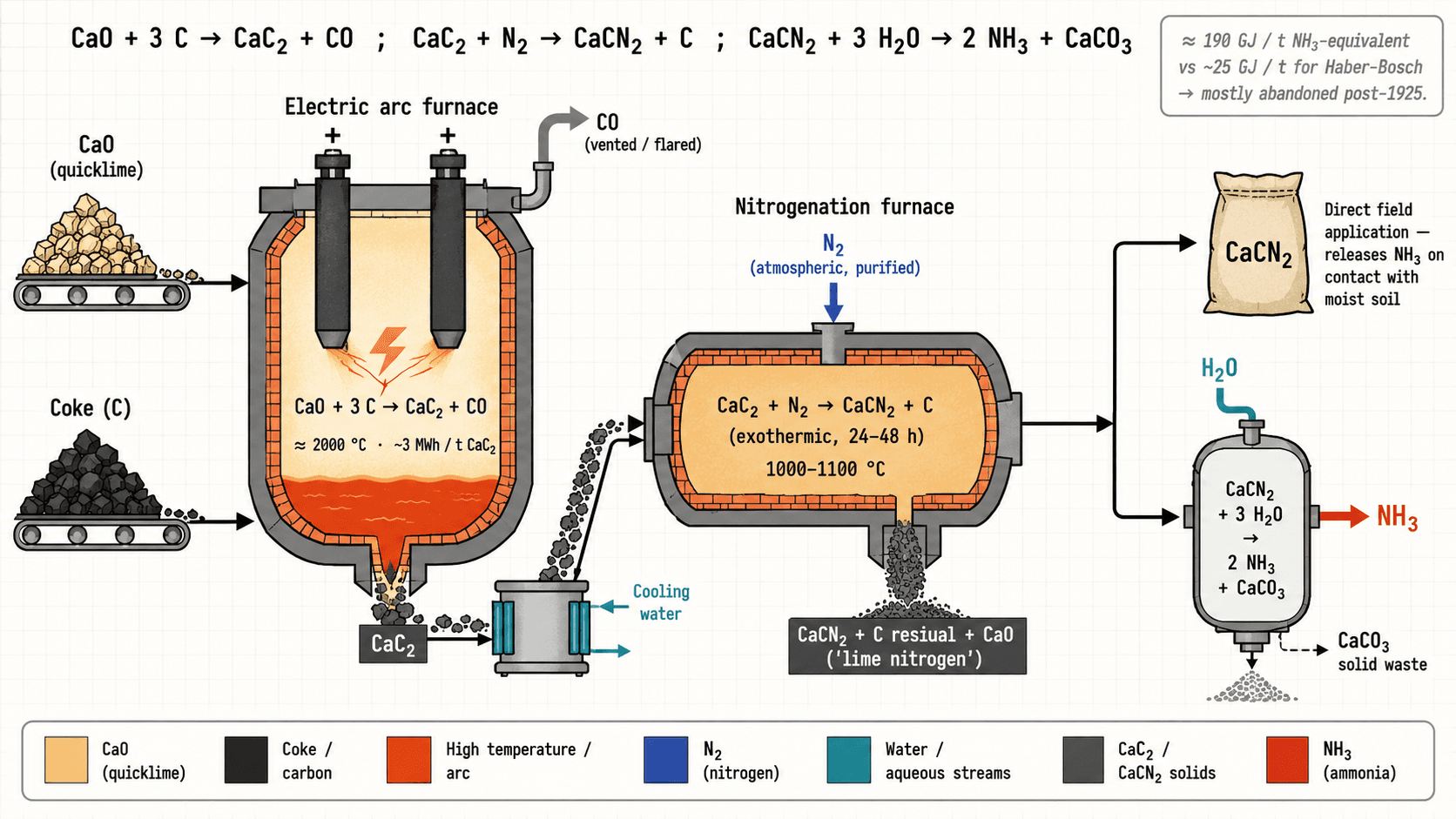
How it works
Molecular synthesis through controlled chemical reactions
Key components
The role of each main part, and the elements / compounds it involves.
Calcium carbide electric arc furnace
Produces calcium carbide CaC₂ by lime reduction with coke at very high temperature.
Open refractory crucible traversed by 3 graphite electrodes (up to 1.5 m diameter), fed CaO and coke. Electric arc maintains ~2000 °C in the bath. Liquid CaC₂ (melting point 2160 °C) is tapped periodically, cooled into blocks and crushed. This step consumes ~3 MWh per tonne of CaC₂ — nearly the entire energy cost of the process.
~2000 °C · 3 MWh/t CaC₂ · électrodes graphite
Nitrogenation furnace
Converts crushed carbide to calcium cyanamide under N₂ atmosphere.
Vertical fixed bed (3-5 m tall) loaded with crushed CaC₂ (~1-3 mm) plus a few % CaF₂ as initiator. Pure nitrogen is injected at the base at 1000-1100 °C. The reaction CaC₂ + N₂ → CaCN₂ + C is exothermic (-291 kJ/mol) but kinetically slow: 24-48 h to reach 95 % conversion. Released heat keeps the furnace at temperature without external supply.
Lit fixe · 1000-1100 °C · 24-48 h batch · CaF₂ amorceur
See alsonh3n2Air separation unit (ASU)
Supplies the pure nitrogen needed for the nitrogenation reaction.
Cryogenic distillation of liquid air to produce N₂ at >99.5 % purity. Compression to 6 bar, cooling to -190 °C, N₂/O₂/Ar separation in tray columns. Consumes ~0.3 MWh per tonne of N₂. Same technology as used in Haber-Bosch — and the only element of Frank-Caro that remains industrially relevant.
>99,5 % N₂ · 6 bar · -190 °C · ~0,3 MWh/t
Physical and chemical principles
The fundamental laws that make this process possible — and the constraints they impose.
Ionic carbide as nitrogen acceptor
CaC₂ is an ionic carbide with the acetylide anion C₂²⁻ — strongly basic in the Lewis sense and electron-donating. It accepts N₂ at high temperature by cleaving the N≡N triple bond (945 kJ/mol) through destabilization within the crystal lattice. This mechanism contrasts with Fe coordination chemistry in Haber-Bosch: here, the ionic bond itself does the work, without metallic catalyst.
CaC₂ + N₂ → CaCN₂ + C (ΔH = −291 kJ/mol)Applies to componentsfour-azotationDownstream hydrolysis for agronomic use
CaCN₂ is not directly assimilable by plants. Once spread on moist soil, it hydrolyses in two stages: CaCN₂ + H₂O → CaO + H₂N-CN (free cyanamide, herbicide), then H₂N-CN + 2 H₂O → CO(NH₂)₂ (urea) → 2 NH₃ + CO₂. Producers valued this delayed-action hydrolysis as a benefit: a single application covered the whole season without leaching.
CaCN₂ + 3 H₂O → 2 NH₃ + CaCO₃
Compounds involved
Input
Output
World production
Main applications
- Direct nitrogen fertiliser ("lime nitrogen")35 %
- Dicyandiamide and resin precursor30 %
- Herbicide / defoliant (pure cyanamide)20 %
- Steel surface case-hardening15 %
Energy and residual commercial niche
- Substitution de carbure synthétisé par carbure recyclé (réduit MWh)
- Couplage avec électricité bas-carbone (Norvège, années 1950-90)
- Repositionnement vers la dicyandiamide (résines plastiques)
Similar or competing processes
Related industrial processes — alternative chemistry, alternative technology.