Bayer process
Refining of pure alumina (Al₂O₃) from bauxite ore by selective dissolution in hot concentrated caustic soda. The mandatory step upstream of Hall-Héroult electrolysis — no Bayer, no aluminium metal.
Operating conditions
- Temperature
- 140-280°C
- Pressure
- 5-40bar
- Catalyst
- NaOH 30-50 % m/m (recyclée)
- Phase
- liquid
How it works
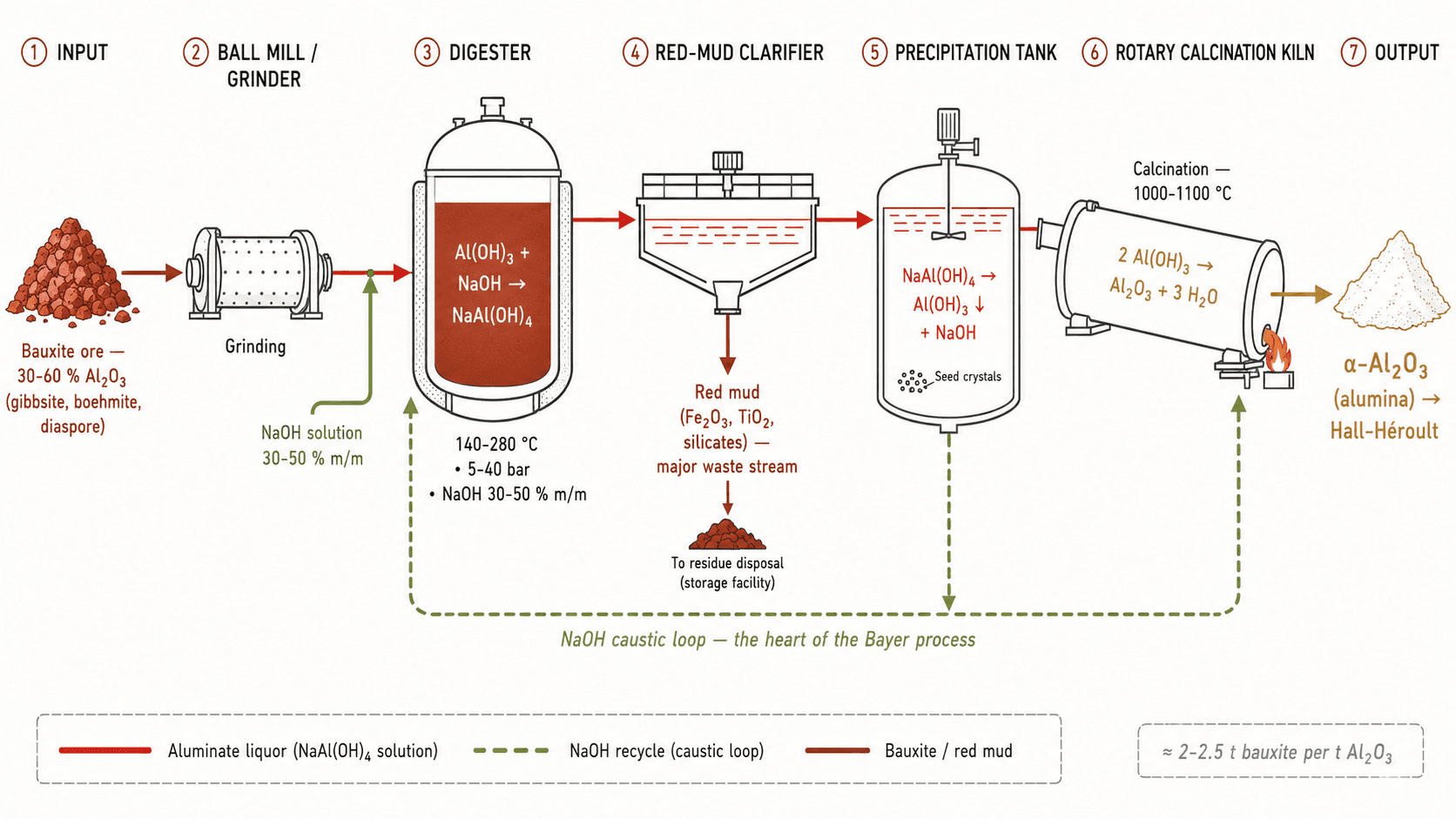
How it works
Extraction and purification of metals
Key components
The role of each main part, and the elements / compounds it involves.
Bauxite grinding
Grinds bauxite into fine particles to maximize contact surface with caustic soda.
Primary crushers + ball mills running in closed circuit with the Bayer liquor. Target particle size ~500 µm. Wet milling in caustic already initiates digestion and improves yield.
Broyage humide · ~500 µm · circuit fermé avec liqueur
Digester (autoclave)
Pressurized vessel where caustic soda attacks bauxite and dissolves aluminium.
Series of vertical steel autoclaves (sometimes Ni-clad above 250 °C), arranged in cascade. Residence time 30-90 min. The 'tube digester' design uses a long steam-heated horizontal tube — more compact and energy-efficient. Pressure is set by water saturation (5 bar at 150 °C, 40 bar at 250 °C).
Acier (Ni-clad) · 5-40 bar · 140-280 °C · cascade ou tube
See alsonaohal-oh-3Red mud thickener
Separates insolubles (Fe, Si, Ti) from the aluminate liquor by gravity settling.
Large-diameter thickeners (~30-50 m) with polymeric flocculants to speed sedimentation. Thickened red mud is countercurrent-washed to recover residual caustic, then stored in lined ponds. Red mud management (Ajka disaster, Hungary 2010) has become a major regulatory issue.
Diamètre 30-50 m · floculants polymères · lavage à contre-courant
See alsofe2o3sio2tio2Precipitators
Crystallize Al(OH)₃ by cooling and seeding the aluminate liquor.
Very large stirred tanks (~5000 m³), gradually cooled from ~75 °C to 50 °C over 30-60 h. Seeded with recycled Al(OH)₃ (~150 g/L of fines). Particle size control is critical for downstream calcination — too fine and the alumina is dusty, too coarse and dissolution in the Hall-Héroult bath slows down.
Cuves ~5000 m³ · 50-75 °C · 30-60 h · ensemencement Al(OH)₃
Calciner (rotary kiln or fluidized bed)
Dehydrates Al(OH)₃ to pure Al₂O₃ and transforms it to the stable α phase.
100 m-long rotary kilns or, more modern, circulating fluidized-bed (CFB) calciners with better efficiency (~3.2 GJ/t Al₂O₃ vs 4.5 GJ for rotary kilns). Temperature 1000-1100 °C, oxidizing atmosphere. Fuel: natural gas or heavy fuel oil — the most CO₂-emitting step of the process.
1000-1100 °C · 3,2-4,5 GJ/t · gaz naturel ou fuel
See alsoal2o3ch4
Physical and chemical principles
The fundamental laws that make this process possible — and the constraints they impose.
Amphoteric behavior of aluminium
Al(OH)₃ dissolves in strong base (forming aluminate Al(OH)₄⁻) AND in strong acid (forming aqueous Al³⁺), but is insoluble between pH 5 and 9. This amphoteric character is exploited to separate Al from Fe (only soluble in acid) and from Si (which forms silicates in base but with manageable kinetics).
Al(OH)₃ + OH⁻ ⇌ Al(OH)₄⁻Applies to componentsdigesteur-bayerKinetics vs equilibrium
At high temperature, digestion is fast and complete but a side reaction with silica forms sodium silico-aluminates (sodalite) that consume caustic soda. The T/time trade-off is tuned to maximize Al yield without wasting caustic — the economic signature of the process.
Compounds involved
Intermediate
Output
By-product
Catalyst
World production
Main applications
- Feedstock for aluminium metal (Hall-Héroult)90 %
- Specialty aluminas (ceramics, abrasives, catalysts)8 %
- High-temperature refractories2 %
Red mud and carbon footprint
- Bauxite faiblement siliceuse (Guinée, Australie) → moins de pertes de soude
- Calcinateurs CFB → −30 % de consommation énergétique
- Digestion à plus haute température (300 °C+) sur diaspore
- Valorisation partielle de la boue rouge en cimenterie (≤ 5 %)
- Procédés alternatifs sans soude en R&D (chloruration, lixiviation acide)
Similar or competing processes
Related industrial processes — alternative chemistry, alternative technology.