Predicted propertiesMany physical properties of this element are theoretical calculated values, not experimental measurements. Transactinides (Z ≥ 104) are only synthesized as a few atoms with very short half-lives. Source: IUPAC 2021.
3D Bohr-model representation of the Nihonium atom (symbol Nh, atomic number Z=113). Electron shell configuration: 2, 8, 18, 32, 32, 18, 3 electrons.
Scroll to activate 3D
Bohr model · educational
Bohr model of nihonium
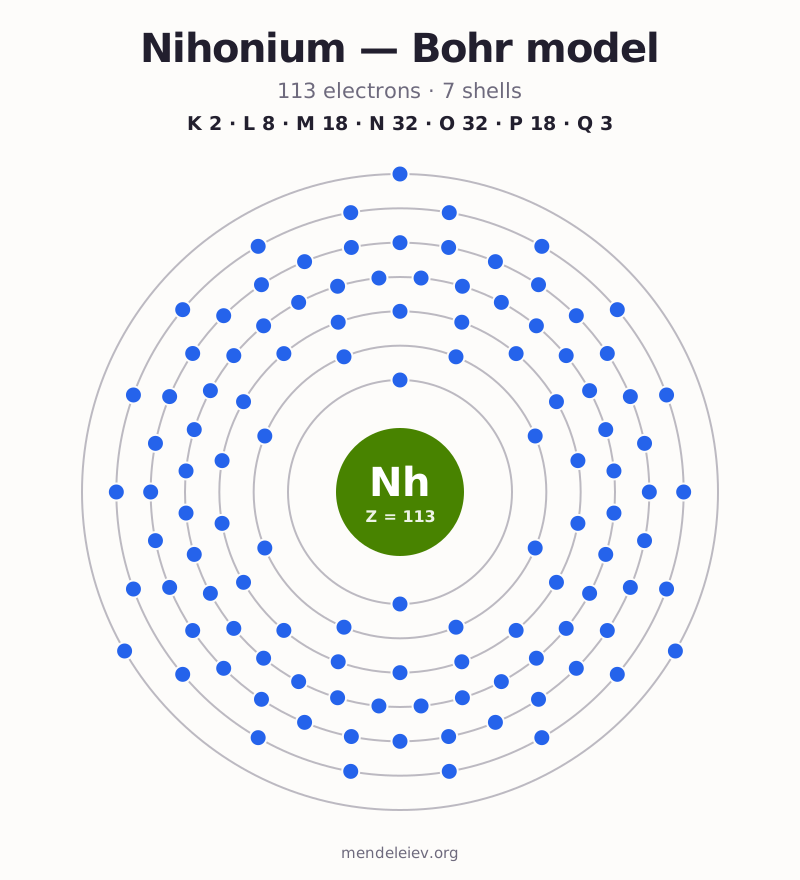
Nihonium (Nh) has 113 electrons, spread over 7 shells. The diagram places them on circles around the nucleus, from the K shell — the closest — outward.
| Shell | Electrons |
|---|---|
| K (n = 1) | 2 |
| L (n = 2) | 8 |
| M (n = 3) | 18 |
| N (n = 4) | 32 |
| O (n = 5) | 32 |
| P (n = 6) | 18 |
| Q (n = 7) | 3 |
The Bohr model is a teaching picture: electrons do not travel in circular orbits, but the number of electrons per shell is exact.
Electron configuration
Full1s² 2s² 2p⁶ 3s² 3p⁶ 3d¹⁰ 4s² 4p⁶ 4d¹⁰ 5s² 5p⁶ 4f¹⁴ 5d¹⁰ 6s² 6p⁶ 5f¹⁴ 6d¹⁰ 7s² 7p¹
Short[Rn] 5f¹⁴ 6d¹⁰ 7s² 7p¹
Valence electrons3
KLMNOPQ shells
K2
L8
M18
N32
O32
P18
Q3
Electronegativity
Pauling—
Allen—
Mulliken (eV)—
Atomic radii
Empirical—
Calculated—
Covalent—
Van der Waals—
Successive ionisation energies
I₁704.9 kJ/mol
Electron affinity—
Oxidation states
-1+1+3+5
Bold states = most common.
Warm-up
Nihonium — do you remember?
3 questions on this page. The right answer shows every time, and nothing is asked of you to play.
No account · one minute